 1770 Hebron Rd Heath, Ohio 43056
 Mon-Friday: 9:00 AM – 6:00 PM
 (740) 967-7833
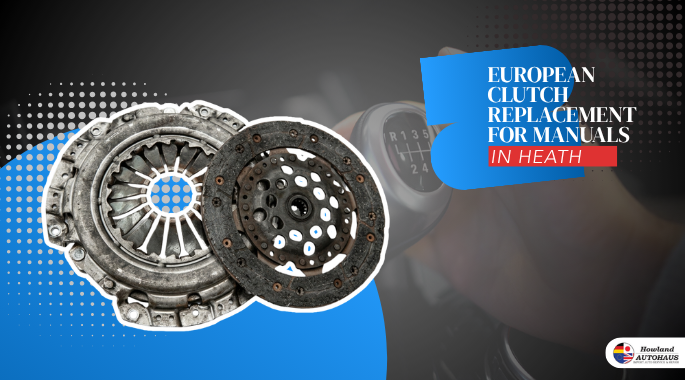
Third gear starts to smell like scorched carpet. Revs climb, the car doesn’t. If your VW, BMW, Mini or Porsche manual has begun slipping on the Hebron Road hill, the clutch has stopped hinting and started warning you.
Manual gearboxes are scarce now, and that scarcity is exactly why some shops guess their way through a clutch job. We do them regularly here in Heath — dual-mass flywheels, hydraulic bleed procedures, torque-to-yield hardware — and most European clutch replacements land between $1,400 and $2,600 depending on the car and the flywheel.
Quick Summary: Key Takeaways
- Slipping is the last stage: high engine rpm with no matching acceleration means the disc is finished, not adjustable.
- Hydraulics fake clutch failure: a leaking slave or master cylinder feels like a dying clutch and costs a fraction to fix.
- Dual-mass flywheels drive the price: resurfacing isn’t an option, and a replacement flywheel alone can run $500 to $900.
- Budget one visit, not two: pilot bearing, throwout bearing, rear main seal and transmission mounts all get done while the box is out.
- Expect 90,000 to 150,000 miles: city driving and hill starts on OH-79 push the low end, steady highway miles push the high.
A slipping clutch gives you weeks of warning before it strands you
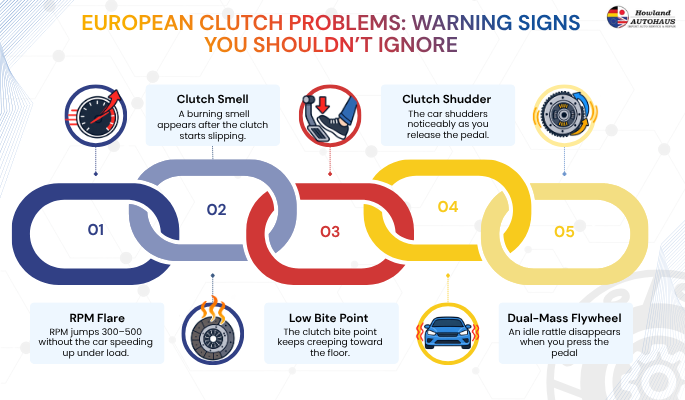
Clutches die slowly. The first sign is usually rpm that jumps 300 to 500 without the car speeding up, most obvious in second or third under load, and it shows up on a hill long before it shows up on flat pavement. Then the smell arrives.
Other tells follow: a bite point that keeps creeping toward the floor, a shudder as you release the pedal, a rattle at idle in neutral that vanishes when you push the pedal in. That last one usually means the dual-mass flywheel, not the disc. Book it now.
Hydraulics fail more often than the disc itself
Half the cars towed in for a bad clutch have a hydraulic problem instead. The VW 02Q gearbox uses a concentric slave cylinder inside the bellhousing, and a master cylinder that leaks past its seal will drop the pedal to the floor without touching the friction disc at all. That’s a much smaller bill.
So we test before we quote. Pedal feel, fluid condition, a look for wetness at the pedal box or the bellhousing weep hole, then a proper bleed. On older BMWs we also check whether the clutch delay valve is still fitted, because removing it sharpens engagement noticeably.
Dual-mass flywheels are why European clutch jobs cost more
Blame the flywheel. It’s the line item that surprises people: most European manuals use a dual-mass design with internal springs to damp driveline shock, and once those springs wear the unit gets replaced rather than machined flat. Skipping it wastes the new clutch.
Manual transmissions have thinned to roughly 1 percent of new vehicles sold in the United States in recent model years, per EPA data on the automotive fleet, which is part of why parts and know-how carry a premium. Plan on $1,400 to $2,600 installed for most cars. Porsche and all-wheel-drive layouts run higher.
Stop-and-go traffic on Hebron Road shortens clutch life
How you drive decides the mileage. Riding the pedal at the OH-79 lights, holding the car on a hill with the clutch instead of the brake, launching hard from a stop — each of those adds heat. Heat glazes the friction disc and cooks the pressure plate springs. Small habits, big difference.
Towing a small trailer to Buckeye Lake counts too. So does commuting into Newark twice a day in traffic. A Granville customer’s GTI gave up at 96,000 miles, while a Pataskala Golf on mostly open road went past 170,000 on the original clutch.
Replacing the clutch is the time to fix what sits behind it
Labor is the expensive part, so do the whole job once. With the transmission out we replace the release bearing, the pilot bearing, the clutch fork and pivot. We also inspect the rear main seal, the input shaft seal, the axle seals and the transmission mounts before a single bolt goes back in. Parts are cheap during that window.
New hardware matters as well. Flywheel and pressure plate bolts on most VW, Audi and BMW applications are torque-to-yield and get replaced, not reused. We also clean and lightly grease the input shaft splines. Cutting corners there is how a fresh clutch develops a shudder in six months.
Heath drivers get manual transmission work done in-house
Sixteen European and import brands come through this shop, and manuals are part of the everyday mix. Audi, BMW, Fiat, Jaguar, Land Rover, Mercedes, Mini, Porsche, Subaru, Toyota, Volkswagen and Volvo all get the same approach: diagnose the hydraulics first, quote the flywheel honestly, then do the work once. Owner Eric Howland drives European cars himself.
No surprise invoices. You’ll hear from us before anything changes on the estimate. Most clutch jobs take one to two days, and we’ll tell you upfront which day the car is going back on the ground. Book it before the slip turns into a tow from Hebron Road.
Frequently Asked Questions
Q: How long should a clutch last on a European car?
A: Typically 90,000 to 150,000 miles. Hill starts, traffic and towing pull that down; steady highway driving stretches it out. We’ve seen well-driven Volkswagens and BMWs pass 170,000 miles on the original disc.
Q: Can I keep driving with a slipping clutch?
A: For a short while, yes, but slipping generates heat that can score the flywheel and pressure plate, which turns a clutch job into a clutch and flywheel job. If it slips in normal acceleration, get it scheduled that week.
Q: Do you have to replace the flywheel with the clutch?
A: On dual-mass flywheels, usually yes. We measure free play and check for scoring and heat cracks first. Reusing a worn dual-mass unit is the most common reason a new clutch shudders a few months later.
Get your clutch diagnosed before it leaves you stranded
Bring the car in while it still drives. We’ll check the hydraulics, measure the flywheel and give you one written number for the whole job.
Hours: Mon–Fri 9:00 AM–6:00 PM; Sat–Sun closed
Website: howlandautohaus.com