 1770 Hebron Rd Heath, Ohio 43056
 Mon-Friday: 9:00 AM – 6:00 PM
 (740) 967-7833
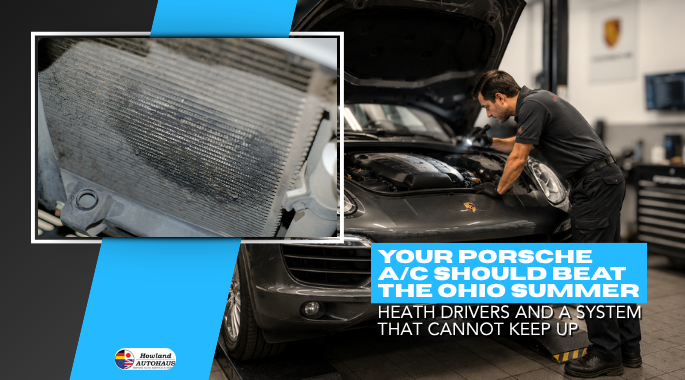
Quick Takeaways:
- Porsche A/C failures cluster around the compressor, condensers, expansion valve, and cooling-fan electronics.
- Many Porsche models use dual condensers mounted low and forward, exposed to road debris and corrosion that cause leaks.
- Cold at speed but warm at idle usually points to condenser airflow or a cooling-fan fault, not low refrigerant.
- Refrigerant is not consumed in a sealed system – repeated recharges mean a leak that must be located and repaired.
- Howland Autohaus at 1770 Hebron Road in Heath uses dye tracing and electronic leak detection to find the exact source before recharging.
By June, the central Ohio heat arrives, and a Porsche’s air conditioning goes from comfort to necessity. Whether you run the I-70 corridor toward Columbus or take a weekend drive to Buckeye Lake, a system that cannot pull a hot cabin down to a comfortable temperature is both miserable and a sign of a developing fault.
Porsche climate systems are well-engineered but not immune to age, heat, and road debris. Howland Autohaus at 1770 Hebron Road in Heath diagnoses a weak A/C system properly – by measuring and locating the actual fault rather than simply adding refrigerant and hoping.
Why does my Porsche A/C blow cold on the highway but warm at idle in Heath?
This pattern points to condenser airflow far more often than to refrigerant charge. At highway speed, air rams through the condensers and carries off the heat the refrigerant has absorbed. At idle, that heat removal depends entirely on the electric cooling fans. A weak fan, or a faulty fan control module, leaves the condensers unable to shed heat – and the vents warm the instant the car stops moving.
The other common cause is condensers clogged with leaves, grit, and salt residue, insulating the fins from airflow. Neither problem is solved by adding refrigerant. Schedule a Porsche A/C inspection at Howland Autohaus in Heath OH. As the U.S. Environmental Protection Agency explains, refrigerant in a sealed system is not used up, so a Porsche that keeps losing its charge has a leak that needs to be found.
Why are Porsche condensers a common source of refrigerant leaks?
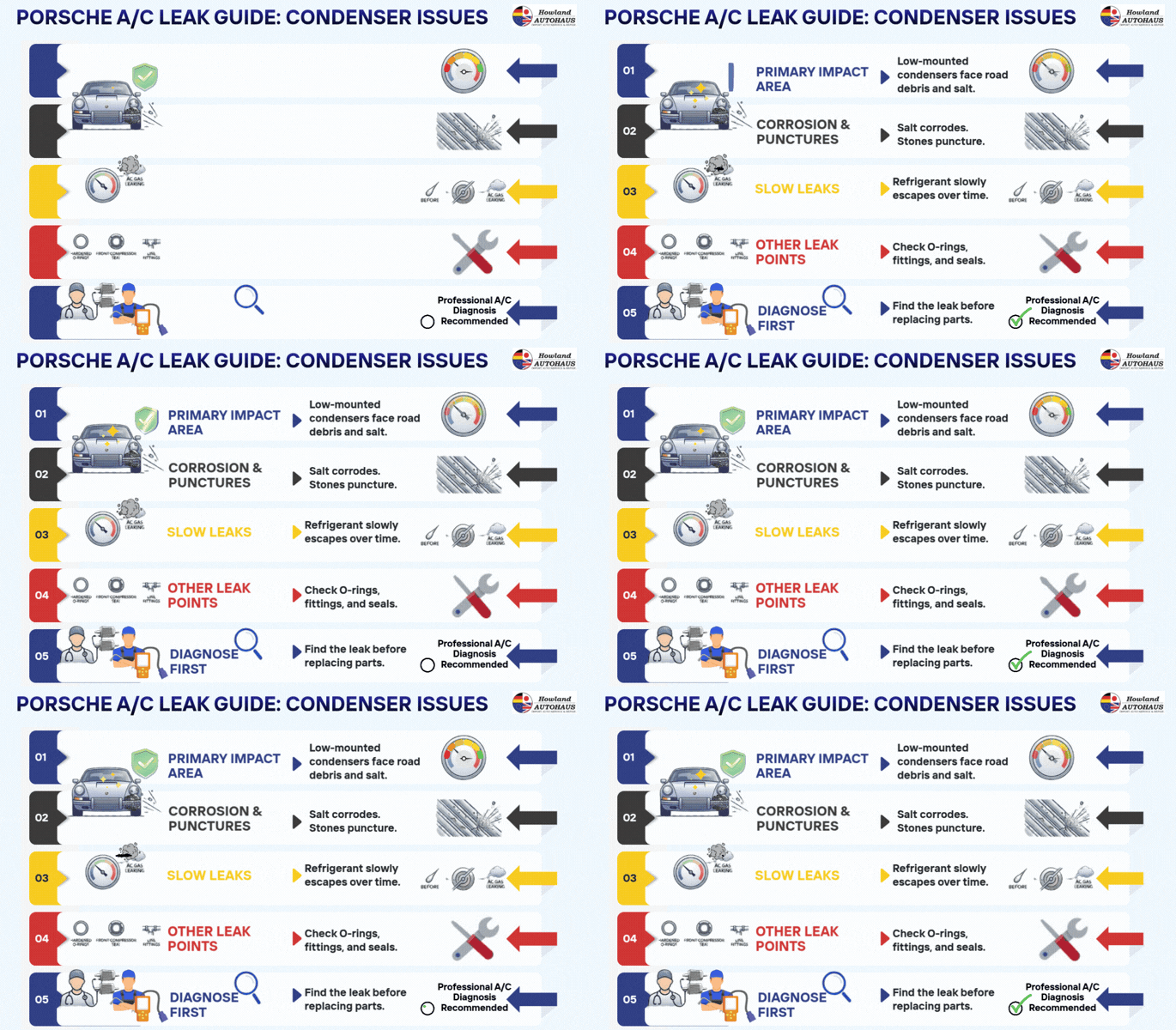
Many Porsche models – 911, Boxster, Cayman, and Cayenne among them – position their condensers low and forward, directly in the path of road debris and salt-laden slush. Over time, this corrodes the thin aluminum tubes, and thrown stones puncture them, producing the slow leaks that show up as a system needing a recharge every season. On dual-condenser layouts, either side can be the culprit, so pinpointing the leak matters before parts are ordered.
Beyond the condensers, the usual aging leak points apply: hardened O-rings at the line fittings and a weeping compressor front seal. Heath’s seasonal swing accelerates both. Contact Howland Autohaus in Heath, OH, about your Porsche’s air conditioning at the first sign of weak cooling.
How does Howland Autohaus find a Porsche refrigerant leak the right way?
The wrong approach is to recharge and send the car back out, only for it to fail again. The correct approach starts with confirming system pressures on manifold gauges, then introducing a UV-reactive dye, running the system, and inspecting every fitting, both condensers, the compressor shaft seal, and the evaporator drain with a UV lamp and an electronic detector.
Once the source is confirmed, the repair targets that specific component, after which the system is evacuated, vacuum-tested, and recharged to Porsche’s exact specification by weight. Book your Porsche A/C service at Howland Autohaus in Heath OH. The shop serves central Ohio and Licking County with over 30 years of combined European auto experience.
What can Heath Porsche owners do to keep the A/C reliable through summer?
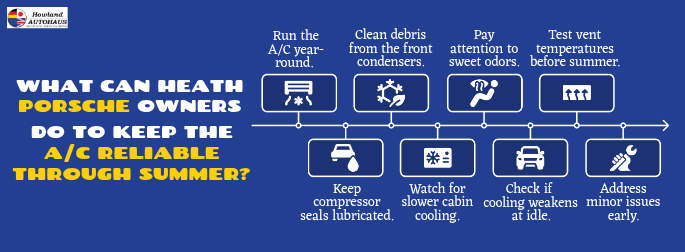
The most valuable habit is running the air conditioning briefly year-round. Circulating refrigerant keeps the compressor’s seals lubricated, preventing the dry-out leaks that surface when demand spikes after months of disuse. Periodically rinsing the front of the car to clear salt, leaves, and grit off the condensers also helps the system reject heat at low speeds.
Watch for early signals: a cabin that takes longer to cool, a faint sweet smell, or air that is cold at speed but tepid at idle. Each points to a specific subsystem, and addressing it before peak summer is cheaper than waiting until the system quits on a 90-degree afternoon.
Frequently Asked Questions
Q: Will a recharge fix my Porsche A/C if it is blowing warm?
A: Only if the system has actually lost charge through a leak – and that leak must be located and repaired first. Howland Autohaus performs leak detection before any recharge.
Q: Why do Porsche condensers fail so often?
A: They sit low and forward, where road debris and winter salt corrode and puncture them. Howland Autohaus inspects both condensers during diagnosis to identify which one is leaking.
Q: My Porsche A/C is cold on the highway but warm at stoplights. What does that mean?
A: That usually points to condenser airflow – a weak cooling fan or debris-clogged condensers – rather than refrigerant charge. Howland Autohaus can confirm and address the specific cause.
Q: Does Howland Autohaus service all Porsche models?
A: Yes – including Boxster, Cayman, Cayenne, Panamera, Macan, and 911 variants. Contact the shop at 1770 Hebron Road to confirm service for your model.
Contact
Howland Autohaus
1770 Hebron Road, Heath, OH 43056
Phone: (740) 967-7833
Website: howlandautohaus.com
Hours: Mon-Fri 9:00 AM – 6:00 PM, Sat-Sun Closed